> ## Documentation Index
> Fetch the complete documentation index at: https://ngquct-docs-fix-500-query-results.mintlify.site/llms.txt
> Use this file to discover all available pages before exploring further.
# SSH Tunneling
> Route database connections through an SSH tunnel to reach servers in private networks
The database **Host** on the General pane is resolved from the SSH server, not from your Mac. A database on the SSH server itself is therefore `localhost`, not the server's public name, and a database elsewhere on the private network is whatever the SSH server calls it (an RDS endpoint, for instance).
```mermaid theme={null}
flowchart LR
TablePro["TablePro
localhost:60000"] -->|"Encrypted tunnel"| SSH["SSH server"] -->|"Internal network"| DB["Database
db:3306"]
```
## Set up a tunnel
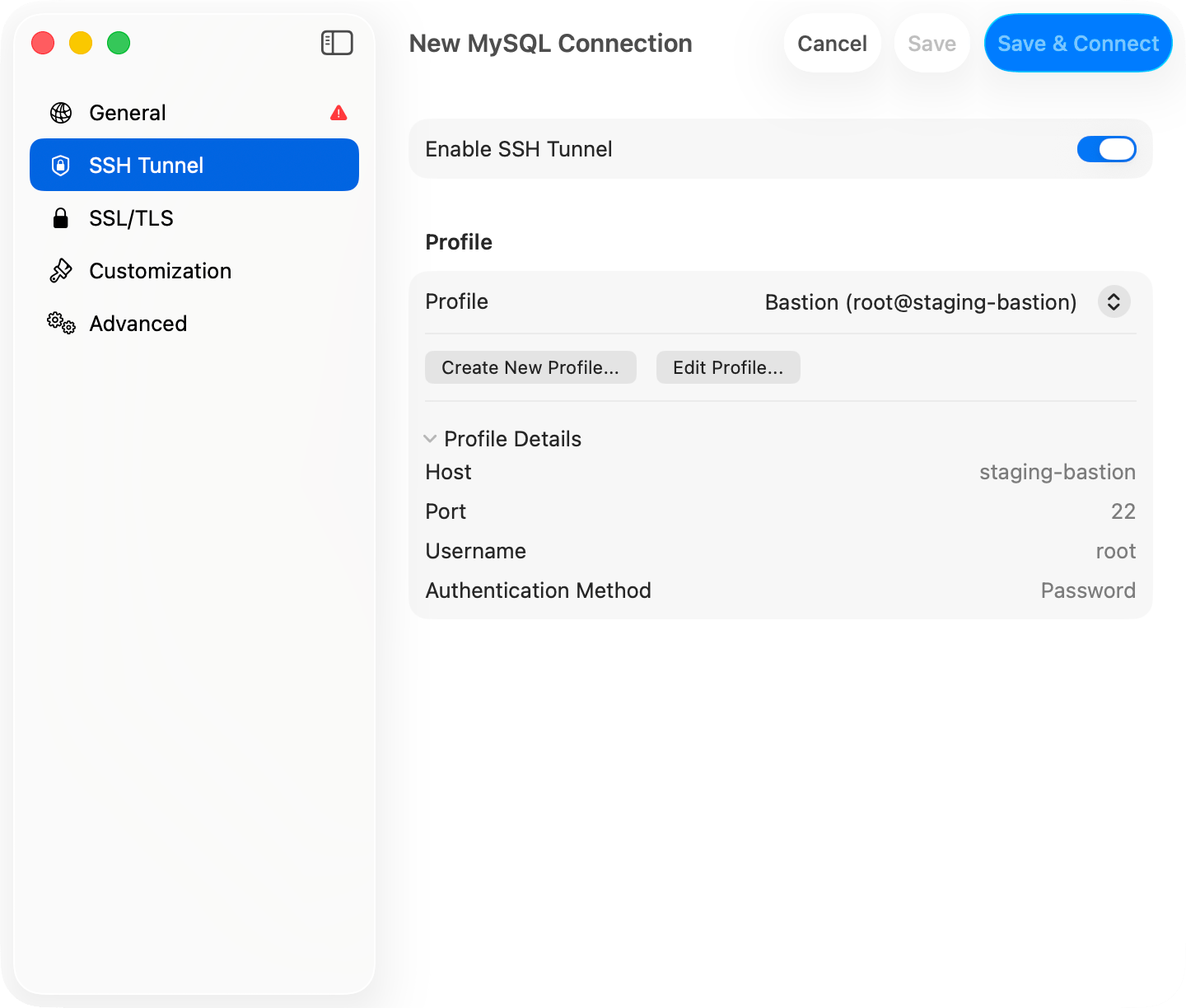
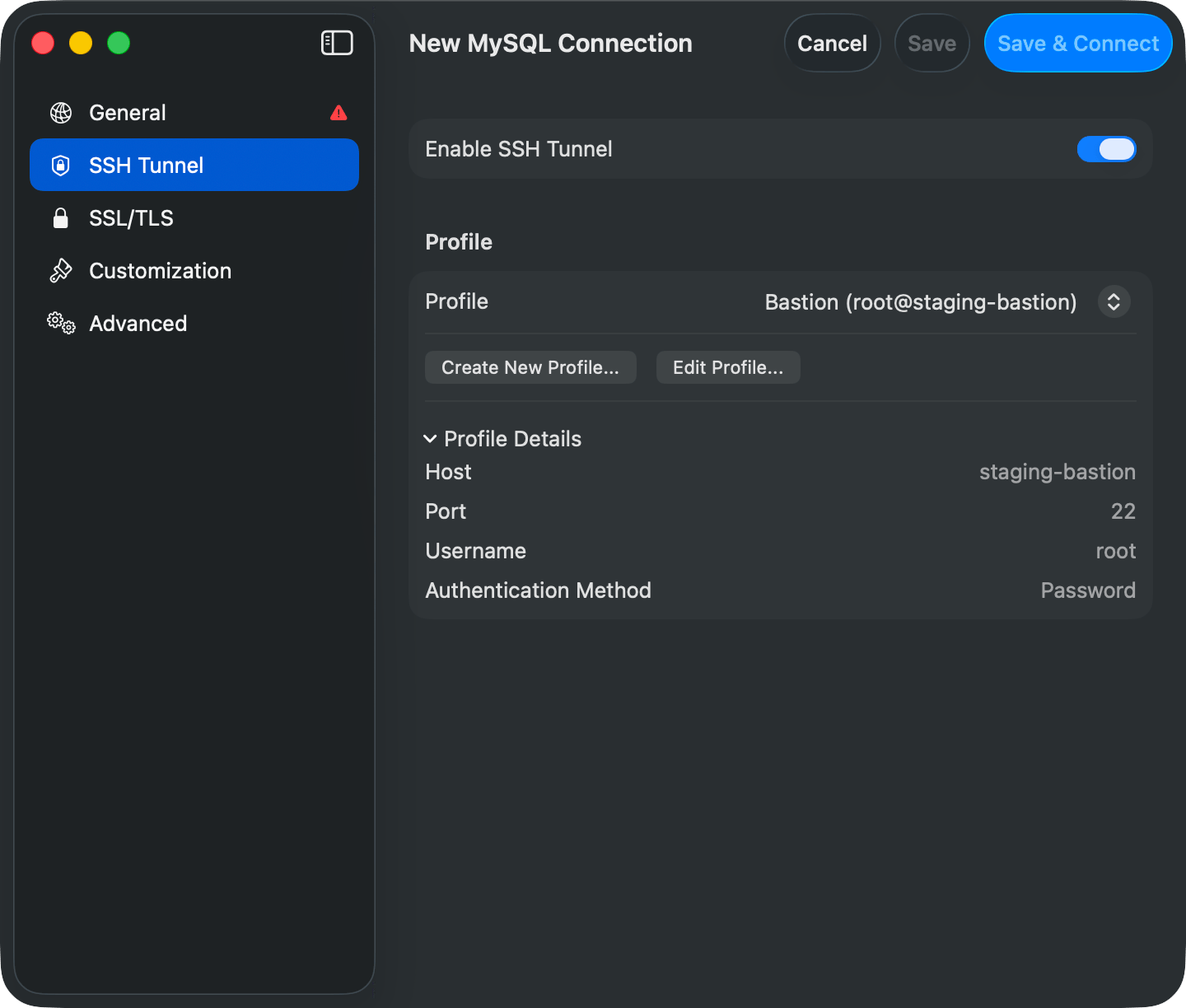
In the connection form, open the **SSH Tunnel** pane and switch on **Enable SSH Tunnel**. A connection uses one transport at a time; if a Cloudflare tunnel, Cloud SQL Auth Proxy, or SOCKS proxy is already on, the pane offers a button to switch it off.
Fill in **SSH Host**, **SSH Port** (22 by default), and **SSH User**. With `~/.ssh/config` entries present, a **Config Host** picker appears above the host field instead.
Password, Private Key, SSH Agent, Keyboard Interactive, or None. [Authentication methods](#authentication-methods) has the fields for each.
Back on **General**, `localhost` reaches a database on the SSH server itself. One on a unix socket needs [Socket Path](#forwarding-to-a-unix-socket) instead.
A wrong host or a blocked forward names the real reason instead of timing out. [Troubleshooting](#troubleshooting) has the three the SSH side reports.
To share one SSH config across connections, save it with **Save Current as Profile…** or pick an existing one from the **Profile** picker; see [SSH Profiles](/connections/ssh-profiles). To fill the whole pane from a string instead, paste a `scheme+ssh://` URL into the [Import from URL…](/connections/urls#ssh-tunnel-format) sheet.
 There is no **SSH Tunnel** pane on SQLite, PGlite, libSQL, Beancount, BigQuery, Cloudflare D1, DynamoDB, Elasticsearch, or Snowflake: each is reached over a local file, a loopback socket, or a vendor HTTP API.
## Authentication methods
| Method | What to fill in |
| ------------------------ | ---------------------------------------------------------------------------------------------------------------------------------------------------------------------------------------------------------------------------------------------------- |
| **Password** | The SSH password. Prefer a key on anything production |
| **Private Key** | **Key File**, with **Browse** to pick one, and **Passphrase** if the key is encrypted. Leaving **Key File** empty auto-detects from `~/.ssh/config` and the default key locations |
| **SSH Agent** | **Agent Socket**: **SSH\_AUTH\_SOCK**, **1Password** (its socket at `~/Library/Group Containers/2BUA8C4S2C.com.1password/t/agent.sock`), or **Custom Path** for Secretive or your own `ssh-agent`. Signing stays in the agent; the key is never read |
| **Keyboard Interactive** | The SSH password, sent through SSH's challenge-response. Use it when the server rejects plain password auth, common with PAM |
| **None** | Nothing, for a server that authenticates the connection itself such as a [Tailscale SSH](https://tailscale.com/kb/1193/tailscale-ssh) host. A server that does want credentials fails the connect with a message naming the other methods |
**Private Key** is the one to pick unless the server only ever issued you a password.
### Verification codes and two-factor authentication
A keyboard-interactive challenge partway through authentication, from `google-authenticator` or `duo_unix` for example, is shown as the server worded it and your answer sent back. Every method except **None** supports this, a key or agent followed by a second factor included (`AuthenticationMethods publickey,keyboard-interactive`).
The **Two-Factor Authentication** section can answer TOTP codes instead. **None** and **Prompt at Connect** both ask when the server does; **Auto Generate** computes the code from the base32 **TOTP Secret** off your authenticator enrollment, with **Algorithm** (SHA1, SHA256, SHA512), **Digits** (6 or 8), and **Period** (30s or 60s) already set to what most servers use.
## Host keys
A first connection shows the server's key type and SHA-256 fingerprint, in `ssh-keygen -l` format, and waits for **Trust**. Trusted keys go to `~/Library/Application Support/TablePro/known_hosts`.
If a trusted server's key later changes, an **SSH Host Key Changed** alert lists the previous and current fingerprints. **Connect Anyway** does not answer the Return key. Escape picks **Disconnect**, which is what to take unless you know the server was reinstalled. With jump hosts, every hop's key is verified the same way.
## Using \~/.ssh/config
Pick an alias from the **Config Host** picker and `HostName`, `User`, `Port`, `IdentityFile`, `IdentityAgent`, and `ProxyJump` are resolved from the config at connect time. Anything typed into the form overrides the file, which is re-read whenever it or an `Include`d file changes.
There is no **SSH Tunnel** pane on SQLite, PGlite, libSQL, Beancount, BigQuery, Cloudflare D1, DynamoDB, Elasticsearch, or Snowflake: each is reached over a local file, a loopback socket, or a vendor HTTP API.
## Authentication methods
| Method | What to fill in |
| ------------------------ | ---------------------------------------------------------------------------------------------------------------------------------------------------------------------------------------------------------------------------------------------------- |
| **Password** | The SSH password. Prefer a key on anything production |
| **Private Key** | **Key File**, with **Browse** to pick one, and **Passphrase** if the key is encrypted. Leaving **Key File** empty auto-detects from `~/.ssh/config` and the default key locations |
| **SSH Agent** | **Agent Socket**: **SSH\_AUTH\_SOCK**, **1Password** (its socket at `~/Library/Group Containers/2BUA8C4S2C.com.1password/t/agent.sock`), or **Custom Path** for Secretive or your own `ssh-agent`. Signing stays in the agent; the key is never read |
| **Keyboard Interactive** | The SSH password, sent through SSH's challenge-response. Use it when the server rejects plain password auth, common with PAM |
| **None** | Nothing, for a server that authenticates the connection itself such as a [Tailscale SSH](https://tailscale.com/kb/1193/tailscale-ssh) host. A server that does want credentials fails the connect with a message naming the other methods |
**Private Key** is the one to pick unless the server only ever issued you a password.
### Verification codes and two-factor authentication
A keyboard-interactive challenge partway through authentication, from `google-authenticator` or `duo_unix` for example, is shown as the server worded it and your answer sent back. Every method except **None** supports this, a key or agent followed by a second factor included (`AuthenticationMethods publickey,keyboard-interactive`).
The **Two-Factor Authentication** section can answer TOTP codes instead. **None** and **Prompt at Connect** both ask when the server does; **Auto Generate** computes the code from the base32 **TOTP Secret** off your authenticator enrollment, with **Algorithm** (SHA1, SHA256, SHA512), **Digits** (6 or 8), and **Period** (30s or 60s) already set to what most servers use.
## Host keys
A first connection shows the server's key type and SHA-256 fingerprint, in `ssh-keygen -l` format, and waits for **Trust**. Trusted keys go to `~/Library/Application Support/TablePro/known_hosts`.
If a trusted server's key later changes, an **SSH Host Key Changed** alert lists the previous and current fingerprints. **Connect Anyway** does not answer the Return key. Escape picks **Disconnect**, which is what to take unless you know the server was reinstalled. With jump hosts, every hop's key is verified the same way.
## Using \~/.ssh/config
Pick an alias from the **Config Host** picker and `HostName`, `User`, `Port`, `IdentityFile`, `IdentityAgent`, and `ProxyJump` are resolved from the config at connect time. Anything typed into the form overrides the file, which is re-read whenever it or an `Include`d file changes.
 ## Jump hosts
For a database behind more than one bastion, expand **Jump Hosts** and add each hop in order. Each hop is an SSH session tunneled through the previous one, with no `ssh` subprocess involved.
| Field | Description |
| ------------ | ------------------------------------------------------------------------ |
| **Host** | Hostname or IP of the jump host |
| **Port** | SSH port, 22 by default |
| **Username** | SSH username for this hop |
| **Auth** | **Private Key** or **SSH Agent**. Password auth is not offered for a hop |
| **Key File** | Private key path, under Private Key auth |
With the list left empty and an SSH host that matches a config entry carrying `ProxyJump`, that directive is followed instead.
## Forwarding to a unix socket
Some servers listen on a unix socket with no TCP port open at all, a PostgreSQL box set up for `local` connections in `pg_hba.conf` being the usual case. Fill in **Socket Path** on the General pane and the forward targets that socket, the same thing `ssh -L 5434:/var/run/postgresql/.s.PGSQL.5432 server` does by hand. **Host** and **Port** are ignored while a socket path is set. Jump hosts still apply: the hops reach the SSH server, and the socket opens from there.
Point at the socket file, not the directory holding it:
| Database | Typical socket path |
| --------------- | ----------------------------------- |
| PostgreSQL | `/var/run/postgresql/.s.PGSQL.5432` |
| MySQL / MariaDB | `/var/run/mysqld/mysqld.sock` |
| Redis | `/var/run/redis/redis.sock` |
`peer` authentication works: the SSH server opens the socket as your SSH login user, so a `local all all peer` line authenticates you as the PostgreSQL role of that name.
A database on a socket cannot negotiate TLS, so SSL is switched off for the connection. The SSH tunnel still encrypts the whole path.
## If the tunnel drops
A keep-alive goes out every 30 seconds. When one fails the session drops to connecting and the tunnel is rebuilt, retrying at 2s, 4s, 8s and doubling to a 120-second ceiling, ten attempts at most. A query in flight dies with the tunnel and is not replayed. After ten failures the session ends with **SSH tunnel disconnected. Click to reconnect.**
If tunnels keep dropping on an idle network, the keep-alive is not the missing piece: check the server's `ClientAliveInterval` and the idle timeouts on any firewall or load balancer in between.
## Troubleshooting
### "The SSH server could not reach …"
SSH is fine and the forward is not. Almost always the **Host** field: that address is resolved from the SSH server, so a database bound to `127.0.0.1` (the MySQL and PostgreSQL default) needs **Host** set to `localhost`. Check what it is bound to with `ss -lntp` on the server. If the host is right, check `sshd_config` for `AllowTcpForwarding yes`.
### "The SSH server did not open a forwarding channel to …"
The destination took the connection and never answered, which usually means a firewall or security group dropping packets rather than refusing them. Test it from the SSH server: `ssh user@server "nc -zv db-host 3306"`.
### "The SSH server would not forward the socket …"
The socket path does not exist on the server, or `sshd_config` sets `AllowStreamLocalForwarding no`. That is a separate setting from `AllowTcpForwarding`.
### The tunnel connects and the database refuses the login
The database credentials are separate from the SSH ones. Check you did not carry one set into the other.
### A firewall prompt on connect
The local end of the tunnel listens on a port between 60000 and 65000. Allow it.
### SSH fails instantly against a server on your own network
macOS 15 and later put outbound connections to local network addresses behind a Local Network permission, and a denied app fails fast with "no route to host". Check TablePro under **System Settings > Privacy & Security > Local Network**. Servers over the internet, and anything on `127.0.0.1`, are unaffected.
### SSH itself fails
Try the same host, user, and key in Terminal with `ssh -v user@server`. If that fails too, the problem is server-side.
## Jump hosts
For a database behind more than one bastion, expand **Jump Hosts** and add each hop in order. Each hop is an SSH session tunneled through the previous one, with no `ssh` subprocess involved.
| Field | Description |
| ------------ | ------------------------------------------------------------------------ |
| **Host** | Hostname or IP of the jump host |
| **Port** | SSH port, 22 by default |
| **Username** | SSH username for this hop |
| **Auth** | **Private Key** or **SSH Agent**. Password auth is not offered for a hop |
| **Key File** | Private key path, under Private Key auth |
With the list left empty and an SSH host that matches a config entry carrying `ProxyJump`, that directive is followed instead.
## Forwarding to a unix socket
Some servers listen on a unix socket with no TCP port open at all, a PostgreSQL box set up for `local` connections in `pg_hba.conf` being the usual case. Fill in **Socket Path** on the General pane and the forward targets that socket, the same thing `ssh -L 5434:/var/run/postgresql/.s.PGSQL.5432 server` does by hand. **Host** and **Port** are ignored while a socket path is set. Jump hosts still apply: the hops reach the SSH server, and the socket opens from there.
Point at the socket file, not the directory holding it:
| Database | Typical socket path |
| --------------- | ----------------------------------- |
| PostgreSQL | `/var/run/postgresql/.s.PGSQL.5432` |
| MySQL / MariaDB | `/var/run/mysqld/mysqld.sock` |
| Redis | `/var/run/redis/redis.sock` |
`peer` authentication works: the SSH server opens the socket as your SSH login user, so a `local all all peer` line authenticates you as the PostgreSQL role of that name.
A database on a socket cannot negotiate TLS, so SSL is switched off for the connection. The SSH tunnel still encrypts the whole path.
## If the tunnel drops
A keep-alive goes out every 30 seconds. When one fails the session drops to connecting and the tunnel is rebuilt, retrying at 2s, 4s, 8s and doubling to a 120-second ceiling, ten attempts at most. A query in flight dies with the tunnel and is not replayed. After ten failures the session ends with **SSH tunnel disconnected. Click to reconnect.**
If tunnels keep dropping on an idle network, the keep-alive is not the missing piece: check the server's `ClientAliveInterval` and the idle timeouts on any firewall or load balancer in between.
## Troubleshooting
### "The SSH server could not reach …"
SSH is fine and the forward is not. Almost always the **Host** field: that address is resolved from the SSH server, so a database bound to `127.0.0.1` (the MySQL and PostgreSQL default) needs **Host** set to `localhost`. Check what it is bound to with `ss -lntp` on the server. If the host is right, check `sshd_config` for `AllowTcpForwarding yes`.
### "The SSH server did not open a forwarding channel to …"
The destination took the connection and never answered, which usually means a firewall or security group dropping packets rather than refusing them. Test it from the SSH server: `ssh user@server "nc -zv db-host 3306"`.
### "The SSH server would not forward the socket …"
The socket path does not exist on the server, or `sshd_config` sets `AllowStreamLocalForwarding no`. That is a separate setting from `AllowTcpForwarding`.
### The tunnel connects and the database refuses the login
The database credentials are separate from the SSH ones. Check you did not carry one set into the other.
### A firewall prompt on connect
The local end of the tunnel listens on a port between 60000 and 65000. Allow it.
### SSH fails instantly against a server on your own network
macOS 15 and later put outbound connections to local network addresses behind a Local Network permission, and a denied app fails fast with "no route to host". Check TablePro under **System Settings > Privacy & Security > Local Network**. Servers over the internet, and anything on `127.0.0.1`, are unaffected.
### SSH itself fails
Try the same host, user, and key in Terminal with `ssh -v user@server`. If that fails too, the problem is server-side.