

localhost, not the server’s public name, and a database elsewhere on the private network is whatever the SSH server calls it (an RDS endpoint, for instance).
Set up a tunnel
1
Turn the tunnel on
In the connection form, open the SSH Tunnel pane and switch on Enable SSH Tunnel. A connection uses one transport at a time; if a Cloudflare tunnel, Cloud SQL Auth Proxy, or SOCKS proxy is already on, the pane offers a button to switch it off.
2
Name the SSH server
Fill in SSH Host, SSH Port (22 by default), and SSH User. With
~/.ssh/config entries present, a Config Host picker appears above the host field instead.3
Pick an authentication method
Password, Private Key, SSH Agent, Keyboard Interactive, or None. Authentication methods has the fields for each.
4
Set the database Host from the server's point of view
Back on General,
localhost reaches a database on the SSH server itself. One on a unix socket needs Socket Path instead.5
Click Test Connection
A wrong host or a blocked forward names the real reason instead of timing out. Troubleshooting has the three the SSH side reports.
scheme+ssh:// URL into the Import from URL… sheet.
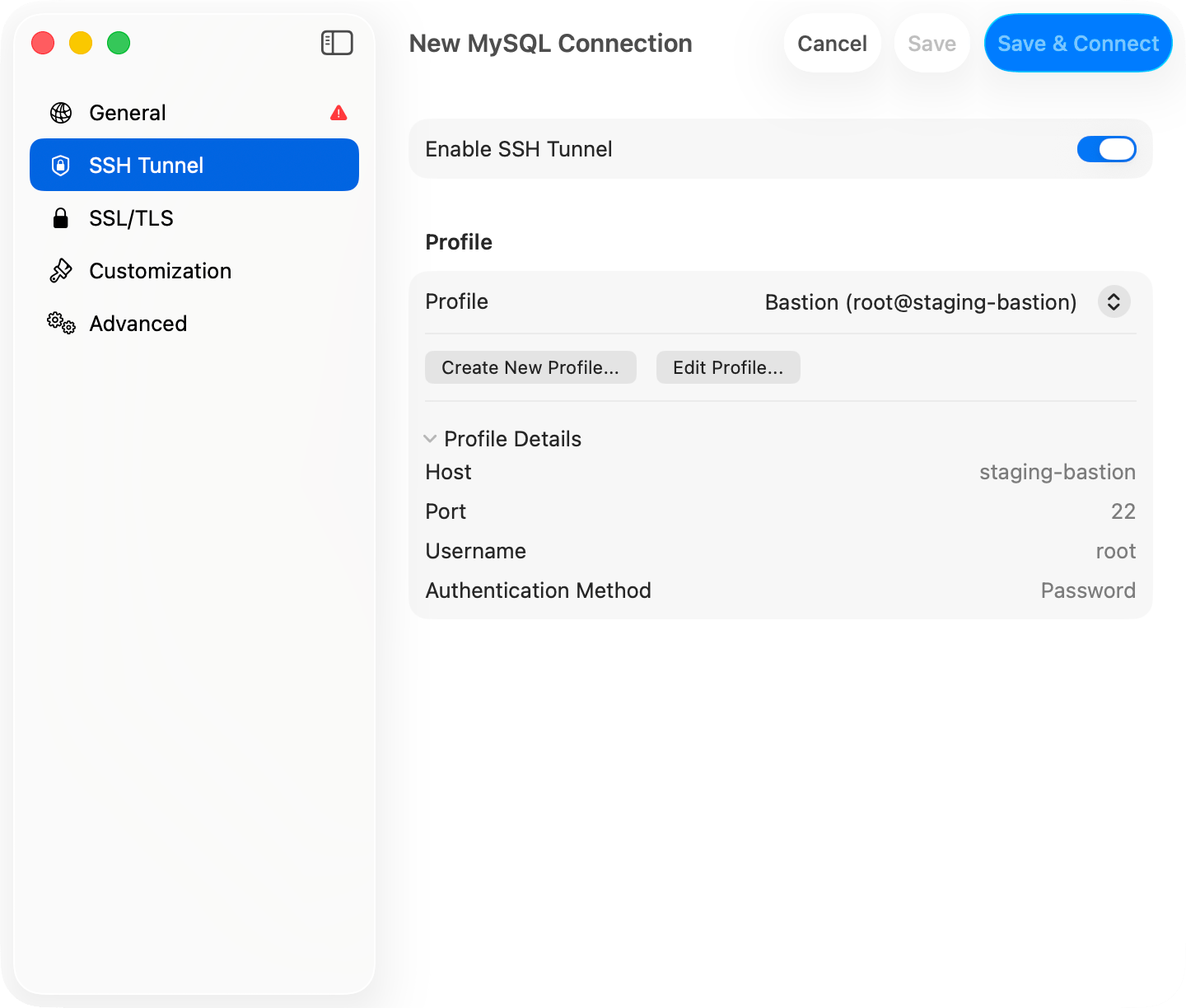
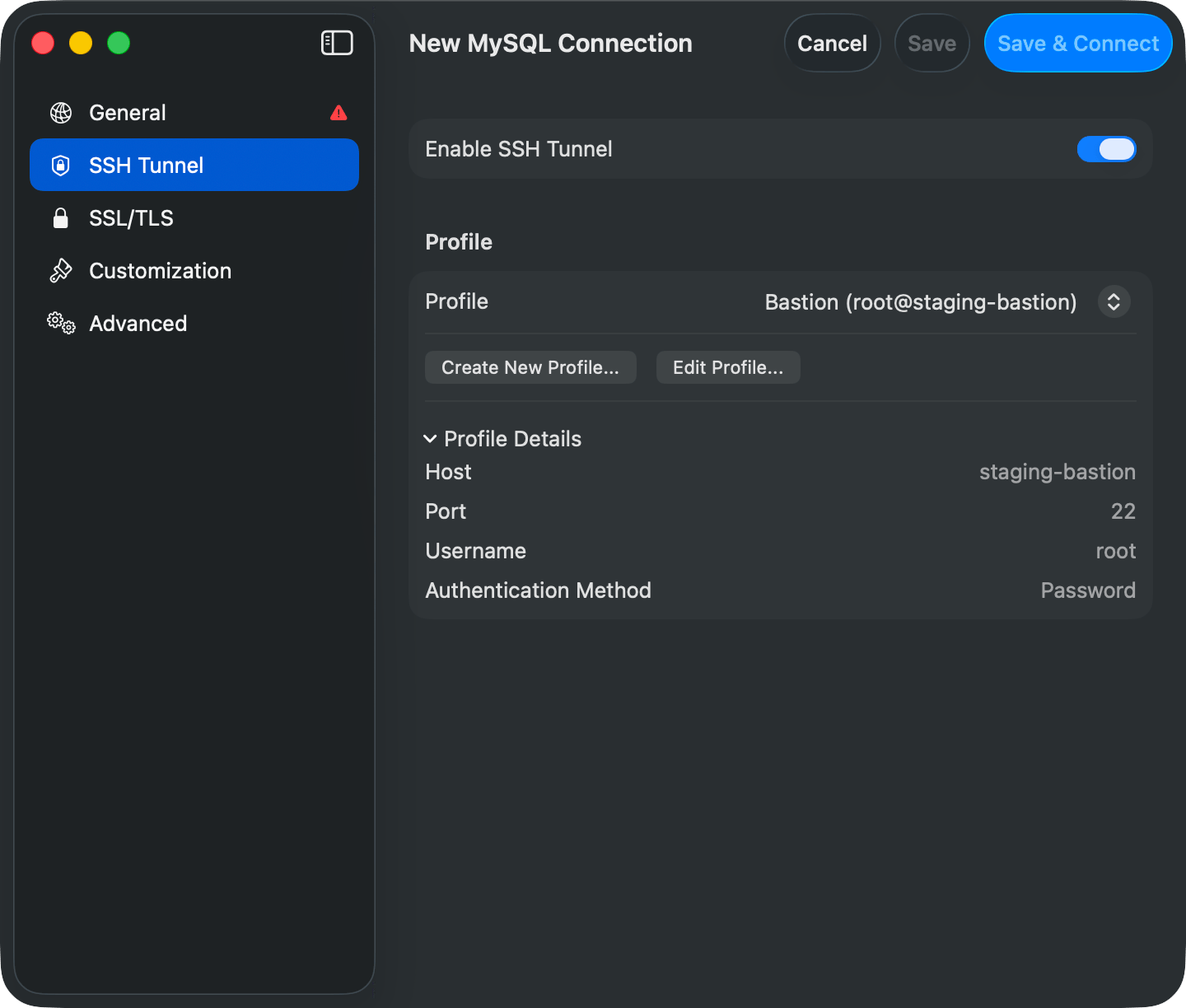
Reusing a saved SSH profile
Authentication methods
Private Key is the one to pick unless the server only ever issued you a password.
Verification codes and two-factor authentication
A keyboard-interactive challenge partway through authentication, fromgoogle-authenticator or duo_unix for example, is shown as the server worded it and your answer sent back. Every method except None supports this, a key or agent followed by a second factor included (AuthenticationMethods publickey,keyboard-interactive).
The Two-Factor Authentication section can answer TOTP codes instead. None and Prompt at Connect both ask when the server does; Auto Generate computes the code from the base32 TOTP Secret off your authenticator enrollment, with Algorithm (SHA1, SHA256, SHA512), Digits (6 or 8), and Period (30s or 60s) already set to what most servers use.
Host keys
A first connection shows the server’s key type and SHA-256 fingerprint, inssh-keygen -l format, and waits for Trust. Trusted keys go to ~/Library/Application Support/TablePro/known_hosts.
If a trusted server’s key later changes, an SSH Host Key Changed alert lists the previous and current fingerprints. Connect Anyway does not answer the Return key. Escape picks Disconnect, which is what to take unless you know the server was reinstalled. With jump hosts, every hop’s key is verified the same way.
Using ~/.ssh/config
Pick an alias from the Config Host picker andHostName, User, Port, IdentityFile, IdentityAgent, and ProxyJump are resolved from the config at connect time. Anything typed into the form overrides the file, which is re-read whenever it or an Included file changes.
Picking a host from ~/.ssh/config
Jump hosts
For a database behind more than one bastion, expand Jump Hosts and add each hop in order. Each hop is an SSH session tunneled through the previous one, with nossh subprocess involved.
With the list left empty and an SSH host that matches a config entry carrying
ProxyJump, that directive is followed instead.
Forwarding to a unix socket
Some servers listen on a unix socket with no TCP port open at all, a PostgreSQL box set up forlocal connections in pg_hba.conf being the usual case. Fill in Socket Path on the General pane and the forward targets that socket, the same thing ssh -L 5434:/var/run/postgresql/.s.PGSQL.5432 server does by hand. Host and Port are ignored while a socket path is set. Jump hosts still apply: the hops reach the SSH server, and the socket opens from there.
Point at the socket file, not the directory holding it:
peer authentication works: the SSH server opens the socket as your SSH login user, so a local all all peer line authenticates you as the PostgreSQL role of that name.
A database on a socket cannot negotiate TLS, so SSL is switched off for the connection. The SSH tunnel still encrypts the whole path.
If the tunnel drops
A keep-alive goes out every 30 seconds. When one fails the session drops to connecting and the tunnel is rebuilt, retrying at 2s, 4s, 8s and doubling to a 120-second ceiling, ten attempts at most. A query in flight dies with the tunnel and is not replayed. After ten failures the session ends with SSH tunnel disconnected. Click to reconnect. If tunnels keep dropping on an idle network, the keep-alive is not the missing piece: check the server’sClientAliveInterval and the idle timeouts on any firewall or load balancer in between.
Troubleshooting
”The SSH server could not reach …”
SSH is fine and the forward is not. Almost always the Host field: that address is resolved from the SSH server, so a database bound to127.0.0.1 (the MySQL and PostgreSQL default) needs Host set to localhost. Check what it is bound to with ss -lntp on the server. If the host is right, check sshd_config for AllowTcpForwarding yes.
”The SSH server did not open a forwarding channel to …”
The destination took the connection and never answered, which usually means a firewall or security group dropping packets rather than refusing them. Test it from the SSH server:ssh user@server "nc -zv db-host 3306".
”The SSH server would not forward the socket …”
The socket path does not exist on the server, orsshd_config sets AllowStreamLocalForwarding no. That is a separate setting from AllowTcpForwarding.
The tunnel connects and the database refuses the login
The database credentials are separate from the SSH ones. Check you did not carry one set into the other.A firewall prompt on connect
The local end of the tunnel listens on a port between 60000 and 65000. Allow it.SSH fails instantly against a server on your own network
macOS 15 and later put outbound connections to local network addresses behind a Local Network permission, and a denied app fails fast with “no route to host”. Check TablePro under System Settings > Privacy & Security > Local Network. Servers over the internet, and anything on127.0.0.1, are unaffected.
SSH itself fails
Try the same host, user, and key in Terminal withssh -v user@server. If that fails too, the problem is server-side.