

Connection settings
Fill in the form and click Save & Connect. For remote servers use SSH tunneling; Google Cloud SQL instances can connect through the Cloud SQL Auth Proxy.
Support starts at 12. An older server still connects, with whatever its catalogs carry: generated columns need 12, declarative partitioning and identity columns need 10.
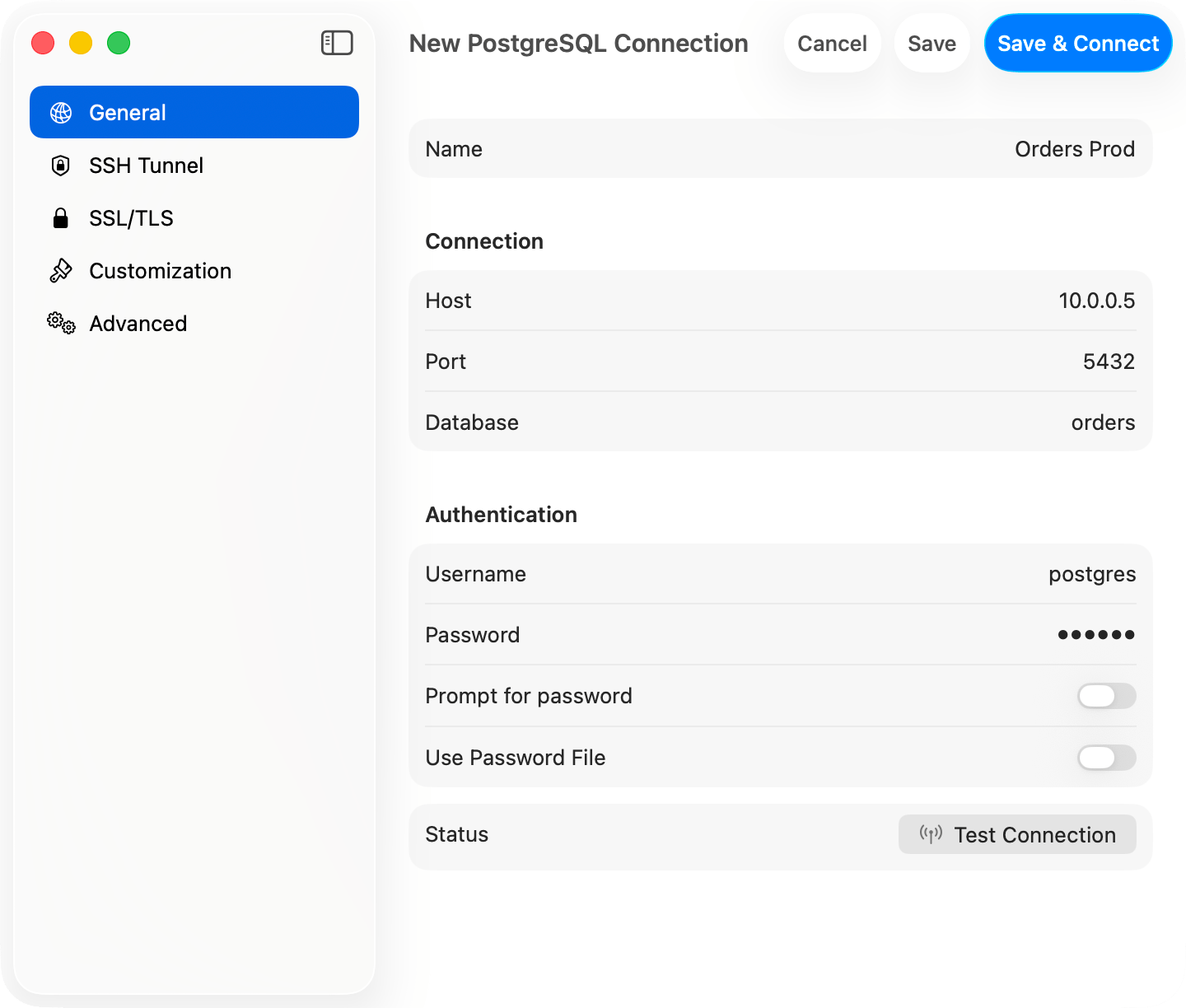
PostgreSQL connection form
Connection URL
postgres:// also works. Opening a URL connects directly. See Connection URL Reference.
Authentication
AWS IAM
Set Authentication to an AWS IAM option and set Username to a database role grantedrds_iam. See AWS IAM Authentication.
Password file
Turn on Use Password File to read the password from~/.pgpass instead of typing one. Entries are hostname:port:database:username:password, * matches any field, first match wins. The form reports what it found, including ~/.pgpass has incorrect permissions (needs chmod 0600), the one that silently blocks a connect.
Databases and schemas
Every database on the server is listed,postgres included; template0 and template1 are not. The sidebar shows every schema you have access to, and the toolbar carries the active database and schema side by side: click either to switch, or press Cmd+K for the database list.
Right-click a schema to drop it. The statement is DROP SCHEMA … CASCADE, so views and functions in other schemas that depend on it go too; the confirmation says so before it runs.
A partitioned table is listed once, under its own icon. Expand it for its partitions, and expand a partition again if it is subpartitioned; opening one works like opening any other table. Tables using the older INHERITS inheritance are listed normally, each child in its own right.
Column types
jsonb renders as formatted JSON, and uuid, inet, timestamp with time zone, interval and bytea display natively. PostGIS geometry and geography render as EWKT with the SRID kept, SRID=4326;POINT(-73 40.7237), rather than raw EWKB hex; a value that fails to convert stays hex.
An array column opens one of two editors, decided by its element type:
In the list editor, reorder rows with the arrows, add and remove elements, and set a single element to NULL; an empty array and a NULL column stay distinct. Enum elements pick from the labels the type declares, and a label the type no longer lists stays selectable and is flagged. Edit as Text switches to the raw literal at any time.
Cross-database tabs
PostgreSQL has no in-placeUSE, so a tab bound to a database other than the connection’s active one runs on a second connection opened for that database. It shares no temp tables, session variables, or open transaction with the query editor on the main connection: keep a multi-statement transaction or a CREATE TEMP TABLE on tabs bound to one database. Binding itself is on Tabs.
Tools
EXPLAIN and EXPLAIN ANALYZE run with FORMAT JSON and render as a plan diagram or tree. See EXPLAIN Visualization. Database > Users & Roles shows where each privilege comes from before you grant or revoke it. Backup Dump and Restore Dump shell out to your local pg_dump and pg_restore; see Backup & Restore.
SSL/TLS
New connections default to Preferred (libpqsslmode=prefer): TLS first, plain text if the server refuses it. Pick Verify CA to validate the server certificate. See SSL/TLS.
Limitations
- Columns cannot be reordered. The structure editor adds, renames, retypes, and drops; changing the order of existing columns means recreating the table.
- A cross-database tab cannot share session state with the main connection. Statements that depend on a temp table or an open transaction have to run on one database.
- Backup and restore need
pg_dumpandpg_restoreon your Mac. Neither is bundled; install them with Homebrew.
Troubleshooting
Connection refused: check the server is running, thatlisten_addresses in postgresql.conf covers remote connections, and that the firewall allows port 5432.
FATAL: password authentication failed for user ”…”: the role and password are checked against pg_hba.conf. Confirm the method on the matching line (scram-sha-256 or md5 for passwords, trust for local dev), and that the line matches the host you are connecting from.
A Postgres-compatible engine loads no tables: wire-compatible engines connect under the PostgreSQL type, and the catalogs they omit are probed for rather than assumed. An engine without pg_matviews still lists its tables; object kinds it does not expose will not appear at all.